


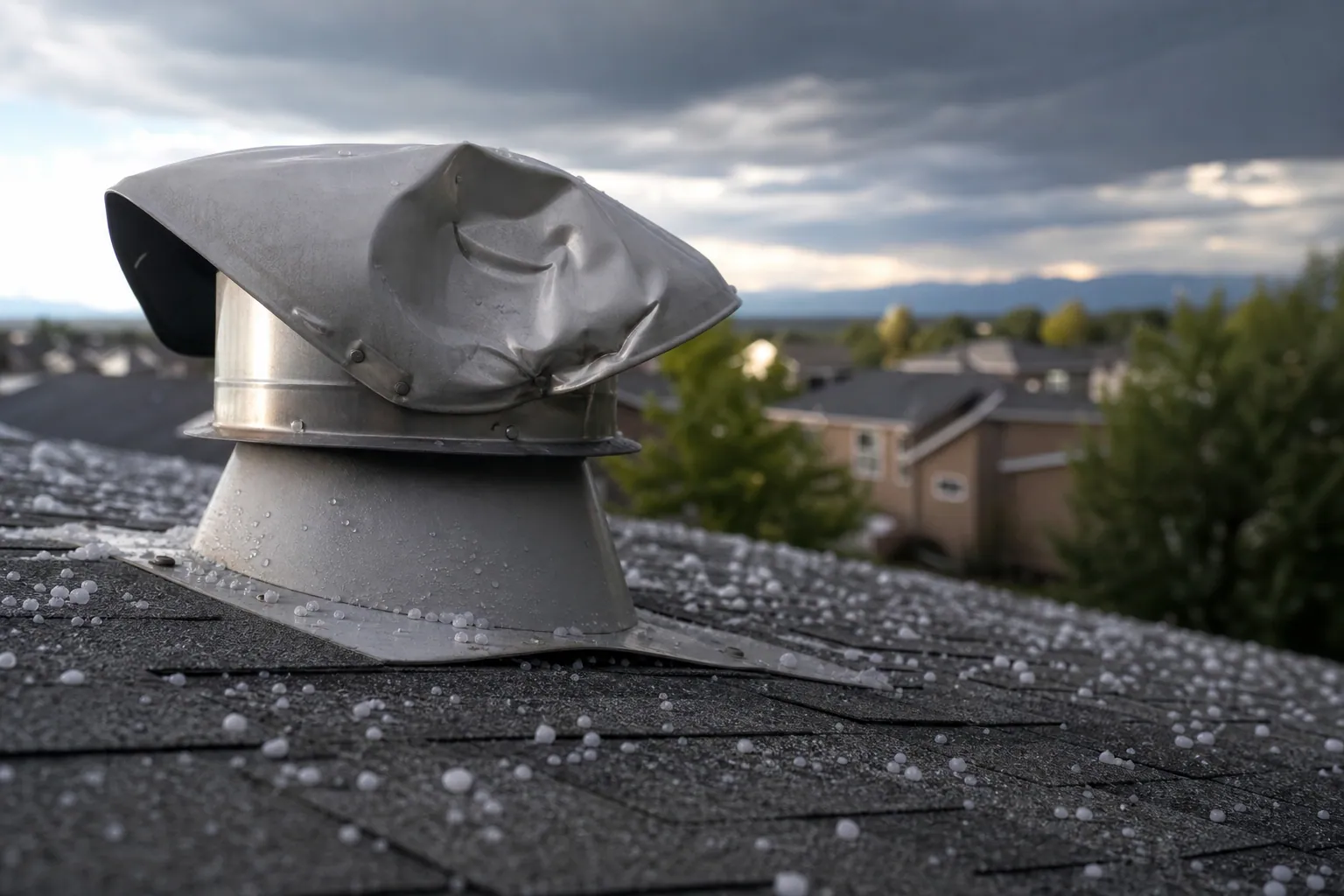
A hailstorm is over in twenty minutes, but what you do in the next two days shapes everything that follows — whether your insurance claim goes through smoothly, whether a small leak becomes a ceiling stain, and whether you pay out of pocket for damage that should have been covered. The good news: the right moves are simple, and almost all of them happen at ground level.
Here's the 48-hour playbook, in order — what to check, what to photograph, when to tarp, and why getting a roofer's inspection report before the insurance adjuster arrives is the single smartest item on the list.
Do not get on the roof. Hail knocks the protective granules loose from asphalt shingles, and a wet, degranulated shingle offers about as much grip as a ski slope. Everything you need to see in the first hour is visible from the ground, ideally with binoculars.
If your soft metals are dented and neighbors are already scheduling inspections, assume your roof took hits too. Hail around 1 inch across — quarter-sized — is generally the threshold where asphalt shingles start to bruise, even when nothing looks torn from the street.
Insurance adjusters work from evidence, and evidence means timestamped photos. Shoot everything before you move a single branch or pick up debris — cleanup can wait an hour, but proof of the storm's severity melts fast.
Keep all of it in one folder on your phone, and hold onto receipts for anything you buy or pay for from this point on. Reasonable emergency expenses are typically reimbursable under your policy's duty-to-mitigate provisions.
If water is coming in, your job is containment: move furniture and electronics, set buckets under drips, and pull back carpet if it's getting soaked. Your policy requires you to prevent further damage where you reasonably can — it does not require you to climb onto a hail-slicked roof.
Emergency tarping is the part to hand off. A professional tarp job runs roughly $300 to $1,000 in 2026 depending on roof size and pitch, it's usually reimbursable through your claim, and it's exactly the kind of work a licensed contractor like Acme Roofing should handle — properly anchored tarps protect the roof without adding new holes, and nobody ends up in the ER.
Here's the step most homeowners skip, and it costs them. Most reputable local roofers will inspect hail damage for free and give you a written report with marked-up photos — bruised shingles, cracked mats, dented vents and flashing, the works.
That report pays off twice. First, it tells you whether the damage clears your deductible before you file — a claim that gets filed and denied still sits in the industry's CLUE database for up to seven years and can nudge your premiums. Second, it gives the adjuster specific, photographed damage to respond to, instead of a quick walkaround on their own terms.
Ask the roofer to be present at the adjuster's inspection. This is standard practice, adjusters expect it, and disagreements about what counts as hail damage get settled a lot faster with both sets of eyes on the same shingle.
Call your insurer or file through the app, get a claim number, and ask two questions: what your wind/hail deductible is, and how long you have to file. Many policies in hail-prone states now carry a separate wind/hail deductible of 1 to 2 percent of your dwelling coverage — on a $350,000 policy, that's $3,500 to $7,000, not the flat $1,000 you might remember.
Run the math against the roofer's estimate. A full asphalt shingle replacement typically runs $12,000 to $25,000 in 2026, so legitimate hail claims usually clear the deductible easily; a handful of damaged shingles may not. And don't sit on it — most policies require prompt notice, and several states cap hail claims at one or two years from the date of loss.
Within days of a major hailstorm, out-of-town crews will canvass the neighborhood. Some are legitimate; enough aren't that it's worth knowing the red flags.
The fix is simple: verify the license number with your state board, ask for a certificate of insurance, and get local references from the last twelve months. A contractor who'll still be in town in five years has no problem with any of that — and neither does your claim.